The Complete Guide to Choosing an Aviation Staffing Partner in 2026
Executive Summary
The aviation industry is entering one of the most challenging workforce environments in its history.
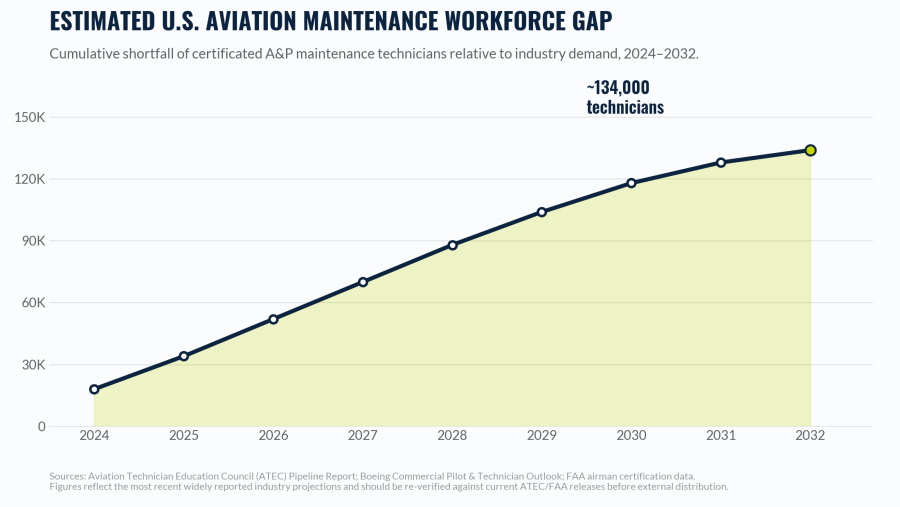
Commercial air travel continues to grow, aircraft fleets are expanding, and maintenance requirements are increasing. At the same time, many experienced aircraft maintenance technicians are reaching retirement age while the pipeline of newly certified mechanics struggles to keep pace with demand. The result is a highly competitive labor market where finding qualified aviation professionals has become one of the biggest operational challenges facing airlines, Maintenance, Repair and Overhaul (MRO) providers, OEMs, and aviation service organizations.
For many organizations, staffing is no longer simply an HR function. It has become a strategic component of operational reliability.
An unfilled maintenance position can delay aircraft deliveries, extend heavy maintenance schedules, increase overtime costs, reduce technician productivity, and ultimately affect aircraft availability. Every hiring decision has downstream implications for safety, compliance, customer satisfaction, and profitability.
Selecting the right aviation staffing partner is therefore about far more than filling vacancies. The best workforce partners help organizations anticipate demand, access specialized technical talent, navigate regulatory requirements, and build long-term workforce resilience.
This guide provides aviation leaders with a practical framework for evaluating staffing partners in 2026. It covers:
- Current aviation workforce trends
- The factors driving today’s mechanic shortage
- The business impact of workforce gaps
- Ten essential criteria for evaluating staffing partners
- FAA and regulatory considerations
- Questions every airline and MRO should ask before selecting a staffing provider
- Common warning signs to avoid
- Best practices for building a long-term workforce strategy
Aviation Staffing Has Become a Strategic Business Decision
There was a time when staffing agencies primarily served as transactional vendors. A maintenance manager submitted a requisition, candidates were sourced, positions were filled, and the engagement ended. Today’s aviation workforce looks very different. Maintenance organizations now compete in an environment shaped by:
- Persistent technician shortages
- Increased fleet utilization
- Aging skilled labor
- Rising maintenance demand
- Higher regulatory expectations
- Greater pressure to reduce aircraft downtime
Finding qualified technicians has become increasingly difficult, particularly for organizations requiring experienced A&P mechanics, avionics specialists, inspectors, structures technicians, and other highly specialized maintenance professionals.
As a result, staffing has evolved into a strategic partnership.
The strongest aviation staffing firms provide more than resumes. They deliver market intelligence, workforce planning support, recruiting expertise, compliance knowledge, and access to highly specialized technical talent that organizations often cannot recruit independently.
Choosing the right partner can improve operational continuity, reduce hiring timelines, and strengthen workforce flexibility during periods of rapid growth or unexpected maintenance demand.
Choosing the wrong partner can create costly delays, inconsistent quality, increased turnover, and unnecessary operational risk.
The State of Aviation Staffing in 2026
Many of today’s experienced aircraft mechanics entered the profession decades ago and are approaching retirement. As these technicians leave the workforce, organizations lose not only labor capacity but also institutional knowledge, mentoring capability, and specialized expertise developed over years of maintaining diverse aircraft fleets.
Replacing this experience is not immediate. Newly certified technicians require time, mentorship, and exposure to complex maintenance environments before reaching comparable proficiency.
Many of today’s experienced aircraft mechanics entered the profession decades ago and are approaching retirement. As these technicians leave the workforce, organizations lose not only labor capacity but also institutional knowledge, mentoring capability, and specialized expertise developed over years of maintaining diverse aircraft fleets.
Replacing this experience is not immediate. Newly certified technicians require time, mentorship, and exposure to complex maintenance environments before reaching comparable proficiency.
Commercial aviation has largely recovered from pandemic-related disruptions, with passenger demand, cargo operations, and fleet expansion driving renewed maintenance activity.
Aircraft deliveries continue across both commercial and business aviation sectors, airlines are expanding routes, and maintenance schedules remain essential for regulatory compliance and operational reliability.
Each additional aircraft entering service creates ongoing demand for:
- Line maintenance technicians
- Heavy maintenance specialists
- Avionics technicians
- Structures mechanics
- Quality inspectors
- Engine specialists
Although aviation maintenance schools continue graduating new technicians each year. Industry forecasts continue to indicate that long-term demand for qualified aviation maintenance technicians is expected to outpace supply.
Competition among airlines, MROs, OEMs, defense contractors, and business aviation organizations means qualified candidates often have multiple employment options.
Organizations are increasingly competing on more than compensation. Career development, scheduling flexibility, relocation assistance, benefits, and workplace culture all influence recruitment and retention.
The aviation staffing conversation has shifted from “Who can fill this position?” to “Who can help us build a resilient maintenance workforce?” Organizations that adopt this mindset are better positioned to reduce downtime, improve technician retention, and respond to future workforce challenges.
A New Way to Evaluate Staffing Partners
Historically, many organizations selected staffing firms using relatively simple criteria:
- Who has candidates available?
- Who can fill positions the fastest?
- Who offers the lowest rates?
Those questions remain important, but they are no longer sufficient.
Leading airlines and MROs increasingly evaluate staffing partners based on long-term value, technical expertise, workforce quality, compliance support, and scalability.
The organizations that consistently outperform their peers recognize that staffing is no longer a commodity service. It is a strategic capability that directly influences operational performance.
In the next section, we’ll introduce the ten evaluation criteria every airline, MRO, and aviation maintenance organization should use when selecting an aviation staffing partner in 2026.
The 10 Criteria Every Airline and MRO Should Use to Evaluate an Aviation Staffing Partner
The Question
Does this firm specialize in aviation, or is aviation simply one of many industries they serve?
This is perhaps the single most important question to ask.
General staffing firms may be highly effective at recruiting administrative, manufacturing, or industrial talent, but aviation maintenance requires an entirely different level of technical understanding.
An aviation recruiter should immediately understand terms like:
- A&P Certification
- Line Maintenance
- Heavy Checks
- Structures
- Avionics
- Sheet Metal
- NDT
- Part 121
- Part 135
- Part 145
- FAA Repair Station
- Return to Service
- AOG
Why It Matters
Specialized recruiters typically:
- Build stronger technician relationships
- Better understand certifications
- Screen more effectively
- Reduce interview time
- Improve quality of hire
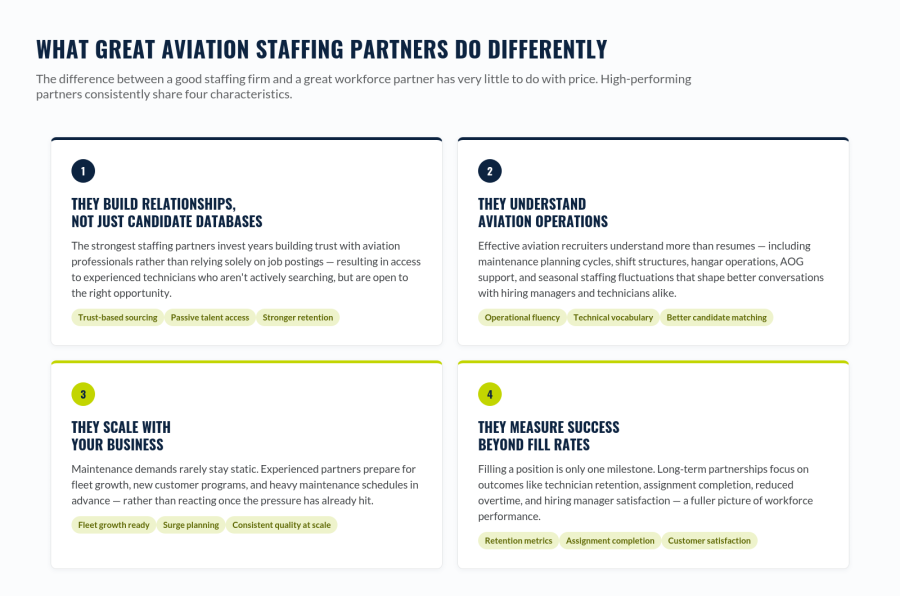
Many staffing firms advertise large candidate databases.
The better question is:
How many active aviation professionals are actually available today?
Qualified aircraft mechanics are rarely sitting on job boards waiting to apply.
The best staffing firms continuously build relationships with technicians long before positions become available.
Look for partners who maintain active networks across:
- A&P Mechanics
- Avionics Technicians
- Aircraft Inspectors
- Structures Technicians
- Interior Specialists
- Engine Technicians
- Composite Specialists
- Manufacturing Support
- Cabin Modification Teams
Questions to Ask
- How many aviation professionals are currently in your network?
- How many are actively available?
- How often do you engage with technicians?
- What percentage are repeat placements?
In aviation, compliance isn’t optional.
Your staffing partner should understand the regulatory environment in which your organization operates.
They should be familiar with:
- FAA regulations
- Documentation requirements
- Certification verification
- Background screening
- Drug testing
- Security clearances
- Customer-specific onboarding
The right partner helps reduce administrative burden while supporting workforce readiness.
Every organization wants positions filled quickly.
But speed alone isn’t the objective.
The real goal is:
Fast placement of qualified technicians who stay.
Fast recruiting with poor candidate quality creates:
- repeat hiring
- additional interviews
- project delays
- higher turnover
Instead, ask staffing partners about:
- Average time-to-fill
- Average deployment time
- Offer acceptance rates
- Candidate retention
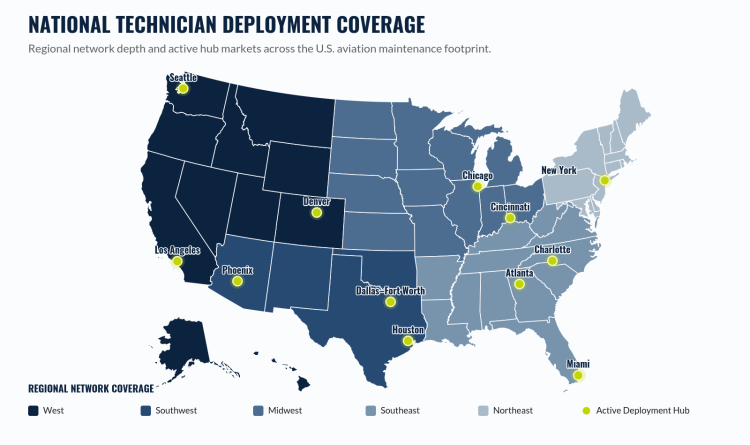
Aircraft maintenance doesn’t happen in one location.
A staffing partner should demonstrate the ability to recruit nationally while understanding regional labor markets.
Can they support:
- Large hubs?
- Regional airports?
- Remote maintenance bases?
- Overnight maintenance projects?
- Temporary surge requirements?
- Multiple states simultaneously?
Organizations operating nationally often benefit from staffing partners with recruiters and technician networks across multiple markets.
Today’s staffing need might involve five technicians.
Next quarter, it could require 150.
A strong aviation staffing partner should demonstrate the ability to scale without sacrificing quality.
Consider asking:
- What’s the largest deployment you’ve managed?
- How quickly can you scale?
- How do you maintain consistency during rapid hiring?
Scalability becomes especially important during fleet expansions, maintenance campaigns, and heavy check programs.
Every staffing conversation should include safety.
Technical qualifications alone aren’t enough.
Strong staffing partners prioritize:
- Safety mindset
- Documentation accuracy
- Professional conduct
- Drug testing
- Background verification
- Customer onboarding
- Continuous communication
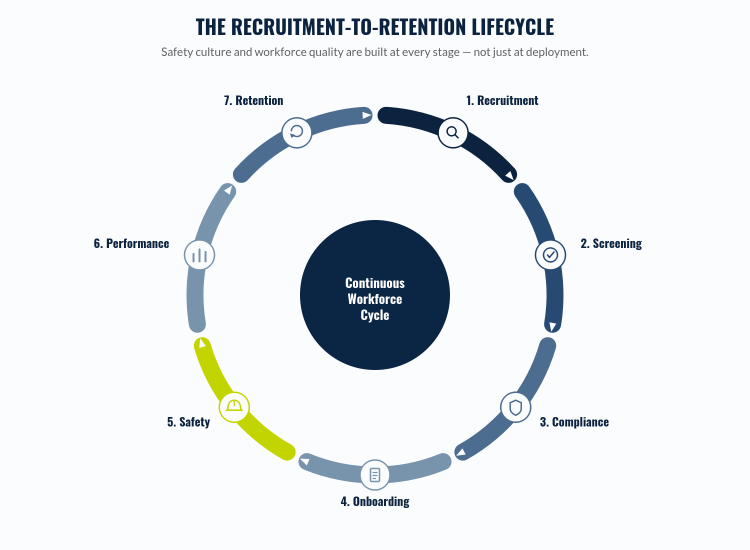
Safety culture begins long before a technician arrives at the worksite.
High turnover creates operational instability.
Each replacement increases costs, disrupts teams, and extends project timelines.
Instead of asking only:
“How quickly can you find someone?”
Also ask:
“How often do your technicians stay through project completion?”
Retention often reflects:
- recruiter relationships
- candidate matching
- communication
- project expectations
- workplace fit
Good Metrics
- Project completion rate
- Assignment extensions
- Redeployment percentage
- Repeat client assignments
The strongest staffing partners provide more than recruiting.
They become workforce advisors.
Examples include:
- Workforce planning
- Market intelligence
- Compensation benchmarking
- Hiring strategy
- Surge planning
- Project staffing
- Direct placement
- Contract staffing
- Contract-to-hire
- Managed workforce programs
Perhaps the most overlooked evaluation criterion is partnership.
Can this organization become an extension of your maintenance operation?
Great staffing partners invest time in understanding:
- your maintenance philosophy
- your culture
- your facilities
- your hiring managers
- your scheduling challenges
- your growth plans
The result is faster hiring, stronger candidate quality, and continuous improvement over time.
Decision Checklist
Before selecting a staffing partner, maintenance leaders should be able to answer “yes” to each of the following:
- Does the firm specialize in aviation?
- Can they explain FAA maintenance environments confidently?
- Do they have an active network of aviation technicians?
- Can they support multiple locations?
- Can they scale with our workforce needs?
- Do they have a documented compliance process?
- Can they provide retention metrics?
- Do they offer strategic workforce planning?
- Can they support both planned and emergency staffing?
- Do they have long-term client relationships in aviation?
Understanding the Aviation Maintenance Environment
Part 121 governs scheduled commercial air carriers.
These organizations typically operate:
- Major airlines
- Regional airlines
- Cargo carriers
Characteristics include:
- Highly structured maintenance programs
- Extensive documentation
- Strict quality systems
- Significant staffing volumes
- Continuous operational schedules
Recruiters supporting Part 121 organizations should understand the pace and expectations of airline maintenance environments.
Many of today’s experienced aircraft mechanics entered the profession decades ago and are approaching retirement. As these technicians leave the workforce, organizations lose not only labor capacity but also institutional knowledge, mentoring capability, and specialized expertise developed over years of maintaining diverse aircraft fleets.
Replacing this experience is not immediate. Newly certified technicians require time, mentorship, and exposure to complex maintenance environments before reaching comparable proficiency.
Part 135 governs many charter operators and commuter airlines.
Maintenance teams often work in smaller, more flexible environments where technicians may perform broader responsibilities.
Successful staffing partners understand the unique operational needs of charter aviation, including rapid response capabilities and geographically dispersed operations.
Many aviation staffing engagements occur within FAA-certified repair stations.
These organizations perform maintenance for airlines, business aviation operators, military programs, and aircraft owners.
Repair stations often experience fluctuating staffing requirements based on customer demand, aircraft induction schedules, and heavy maintenance projects.
Experienced staffing partners understand these project-based staffing cycles and maintain technician networks capable of supporting them.
The Cost of Poor Documentation
Technical skill is only part of the hiring process.
Documentation matters just as much.
Maintenance organizations should expect staffing partners to have structured processes for verifying information before deployment.
This often includes:
- FAA certificate verification
- Employment history
- Technical experience
- Drug screening (where required)
- Background screening
- Right-to-work documentation
- Customer onboarding requirements
The stronger the documentation process, the smoother onboarding becomes.
Beyond the Resume
- Certifications
- Aircraft platforms
- Maintenance experience
- Inspection experience
- Troubleshooting ability
- Travel availability
- Shift flexibility
- Project duration
- Security requirements
- Start date
- Communication
- Teamwork
- Reliability
- Safety mindset
- Customer interaction
Red Flags to Watch For
“We recruit for every industry.”
Breadth isn’t necessarily a strength.
Organizations recruiting simultaneously for healthcare, retail, IT, construction, hospitality, and aviation may struggle to maintain deep technical expertise within each sector.
Pricing Is the Primary Differentiator
Lowest cost rarely produces the strongest workforce.
Organizations should evaluate:
- quality
- retention
- responsiveness
- compliance
- technical expertise
Limited Aviation References
Experienced staffing partners should be able to demonstrate long-term aviation relationships.
Ask for examples of work supporting:
- Airlines
- MROs
- OEMs
- Manufacturing facilities
No Defined Compliance Process
Every staffing provider should be able to clearly explain:
- candidate screening
- documentation
- onboarding
- quality control
- issue resolution
Reactive Recruiting
If recruiting begins only after receiving a requisition, hiring timelines often increase.
The strongest staffing firms continuously recruit, build relationships, and maintain active candidate pipelines.
No Performance Metrics
Professional staffing organizations measure performance.
Typical KPIs include:
- Time to submit
- Time to fill
- Retention
- Assignment completion
- Customer satisfaction
- Redeployment
Compliance should never slow down hiring. It should make hiring more predictable, more consistent, and less risky. The strongest aviation staffing partners combine technical recruiting expertise with disciplined documentation, proactive workforce planning, and a deep understanding of the environments in which their clients operate.
Workforce Planning Is Becoming a Competitive Advantage
Many organizations still approach staffing reactively.
A project begins.
A vacancy appears.
A requisition is submitted.
Recruiting starts.
Leading organizations increasingly take a different approach.
They work with staffing partners throughout the year to:
- anticipate seasonal demand
- monitor labor market conditions
- identify future hiring needs
- maintain technician pipelines
- reduce hiring delays
- support expansion initiatives
Instead of asking, “Can you fill this opening?”
They ask,
“How can we build a workforce strategy that supports our business over the next three years?”
That shift represents one of the most significant changes occurring across aviation staffing today.
Where LAUNCH Fits
For over 15 years, LAUNCH Technical Workforce Solutions has focused on helping aviation organizations solve complex workforce challenges.
Rather than serving as a general staffing provider, LAUNCH has built its business around the technical workforce that keeps aircraft flying.
Its services support organizations across the aviation ecosystem, including airlines, MROs, OEMs, aerospace manufacturers, and other aviation employers.
Capabilities include:
- Contract staffing
- Direct hire recruiting
- Contract-to-hire solutions
- Project-based workforce support
- Aviation maintenance recruiting
- Avionics staffing
- Manufacturing staffing
- Workforce planning
Because LAUNCH maintains dedicated aviation recruiting teams and an established network of technical professionals, clients gain access to specialized talent while reducing the time and effort required to identify qualified candidates.
Most importantly, LAUNCH’s approach aligns with the evaluation framework presented throughout this guide:
- Aviation specialization
- Technical recruiting expertise
- National reach
- Scalable workforce solutions
- Compliance awareness
- Long-term client partnerships
Rather than viewing staffing as a transactional service, LAUNCH works with organizations to build workforce strategies that support operational continuity and future growth.
Frequently Asked Questions
Aviation maintenance requires specialized technical knowledge, regulatory awareness, and access to qualified professionals with aviation-specific experience. Firms focused on aviation are typically better positioned to identify, evaluate, and recruit candidates who meet these requirements.
At a minimum, staffing partners should understand FAA Airframe and Powerplant (A&P) certification, along with the operational environments governed by Part 121, Part 135, and Part 145 regulations. Depending on the role, additional aircraft-specific experience or manufacturer training may also be important.
Timelines vary depending on the role, location, required certifications, and labor market conditions. Organizations with established talent pipelines are generally able to respond more quickly than firms that begin recruiting only after receiving a job order.
No. Many organizations use a blended workforce strategy that combines direct hires with contract or project-based staffing. This approach provides greater flexibility while maintaining a stable core workforce.
Beyond time-to-fill, organizations should consider:
- Candidate quality
- Technician retention
- Assignment completion
- Compliance support
- Workforce scalability
- Client communication
- Long-term partnership
Final Thoughts
The aviation workforce will continue to evolve over the coming decade.
As experienced technicians retire, fleets expand, and maintenance demands increase, organizations will face continued pressure to attract and retain qualified technical talent.
The companies that thrive will not necessarily be those with the largest recruiting budgets or the most recognizable brands.
They will be the organizations that build strong workforce strategies, invest in long-term partnerships, and treat staffing as a competitive advantage rather than a reactive necessity.
Choosing the right aviation staffing partner is one of the most important decisions maintenance leaders can make. The right partner can help reduce downtime, improve workforce stability, and position your organization to respond with confidence to changing operational demands.
About LAUNCH Technical Workforce Solutions
Since 2011, LAUNCH Technical Workforce Solutions has connected aviation organizations with the skilled professionals who keep the industry moving.
From contract staffing and direct hire recruiting to project-based workforce solutions, LAUNCH partners with airlines, MROs, OEMs, and aerospace manufacturers across the United States to help solve today’s workforce challenges while preparing for tomorrow’s opportunities.
Whether your organization is expanding operations, preparing for peak maintenance demand, or developing a long-term workforce strategy, LAUNCH brings the industry expertise, recruiting capabilities, and technical focus needed to support your success.